
Volume 1, Issue 2
Article Type: Research Article
Differences in gender and geographic region affect the association between leisure-time physical activity and negative self-rated health among older Brazilians
Thiago Ferreira De Sousa1; Sandra Celina Fernandes Fonseca2*; José Carlos Aragão-Santos1; Aline De Jesus Santos1; Silvio Aparecido Fonseca1
1Department of Health Sciences, Santa Cruz State University, Postgraduate Program in Physical Education, Ilhéus, BA, Brazil.
2Research Center in Sports Sciences, Health Sciences and Human Development, Department of Sports, Exercise and Health Sciences, University of Trás-os-Montes and Alto Douro, Vila Real, Portugal.
*Corresponding author: Sandra Celina Fernandes Fonseca
Research Center in Sports Sciences, Health Sciences and
Human Development, Department of Sports, Exercise and Health Sciences, University of Trás-os-Montes and Alto Douro, Vila Real, Portugal.
Email ID: sfonseca@utad.pt
Received: Nov 13, 2025
Accepted: Dec 02, 2025
Published Online: Dec 09, 2025
Journal: Annals of Gerontology and Geriatrics
Copyright: Fonseca SCF et al. © All rights are reserved
Citation: Sousa TFD, Fonseca SCF, Aragao-Santos JC, Santos ADJ, Fonseca SA. Differences in gender and geographic region affect the association between leisure-time physical activity and negative self-rated health among older Brazilians. Ann Gerontol Geriatr. 2025; 1(2): 1027.
Abstract
Introduction: Population aging in Brazil has been accompanied by an increase in the prevalence of chronic diseases and a decline in physical activity, both of which directly affect health perceptions among older adults.
Objective: To estimate the association between leisuretime physical activity and negative health self-rated in older adults living in Brazilian capitals, considering gender and geographic region.
Methods: A cross-sectional study based on data from VIGITEL 2023, including a sample of 6,940 older adults (≥60 years). Sociodemographic, behavioral, and physical activity variables were analyzed. The association between leisuretime physical activity and negative self-rated health was estimated using Odds Ratios (ORs) with 95% confidence intervals (95% CIs), in both crude and adjusted models.
Results: The prevalence of leisure-time physical inactivity was high in both sexes, with a higher proportion among women (ranging from 69.9% in the Central-west to 77.2% in the Southeast). Negative health perception was more frequent among physically inactive older adults. In the adjusted analysis, the absence of leisure-time physical activity was significantly associated with negative selfrated health in all regions, particularly among men in the Southeast (OR=27.46; 95% CI: 25.94-29.06) and women in the Northeast (OR=6.29; 95% CI: 6.10-6.49).
Conclusion: Insufficient leisure-time physical activity is strongly associated with negative self-rated health among Brazilian older adults, with regional and sex-related variations. These findings reinforce the importance of public policies aimed at promoting physical activity, with particular attention to socioeconomic and gender inequalities.
Keywords: Physical activity; Health; Brazil.
Introduction
Population aging constitutes one of the main challenges for health systems worldwide, particularly in developing countries [1,2]. In Brazil, the proportion of older adults is increasing rapidly, accompanied by a rise in the prevalence of chronic diseases and functional limitations [3]. In this context, promoting health and quality of life in old age has become a priority on public health agendas [4,5].
Among the determinants of healthy aging, regular physical activity plays a central role [6,7]. In addition to contributing to the prevention and control of cardiovascular, metabolic, and musculoskeletal diseases, physical activity is also associated with a positive perception of health status [8,9].
However, studies indicate that adherence to active leisure practices among Brazilian older adults remains low, with marked inequalities according to sex, educational level, and region of the country [10]. Women exhibit higher levels of physical inactivity, while the North and Northeast regions concentrate populations with poorer socioeconomic conditions and limited access to health services [10,11].
Subjective health perception is recognized as a robust indicator of overall well-being and mortality risk, being influenced by physical, psychological, and social factors [12-14]. Therefore, understanding the relationship between leisure-time physical activity and self-rated health among older adults is essential to inform public policies aimed at promoting healthier and more equitable aging [6,7].
Understanding the dynamics of leisure-time physical activity among this population, originating from a developing country where such behavior is, in most cases, not a matter of choice but the result of a lack of opportunities [15], can provide valuable insights for policies aimed at promoting active aging. In this context, the objective was to estimate the association between leisure-time physical activity and negative health self-rated in older adults living in Brazilian capitals, using data from the 2023 VIGITEL system, considering gender and geographic region.
Methods
Study design
This investigation corresponds to a secondary analysis of publicly available data from the Risk Factor and Health Protection Surveillance System for Chronic Diseases by Telephone Survey (VIGITEL), conducted in 2023. The VIGITEL study received approval from the National Research Ethics Commission of the Brazilian Ministry of Health (CAAE: 65610017.1.0000.0008), and it is in accordance with the principles of the Declaration of Helsinki. All respondents provided verbal consent before participation.
Participants and procedures
The VIGITEL was launched in 2006 as a nationwide surveillance initiative coordinated by the Brazilian Ministry of Health. Its goal is to monitor chronic non-communicable diseases and their associated risk and protective factors. Each year, crosssectional data is collected through telephone and cell phone interviews with adults aged 18 years and older who reside in the 26 state capitals and the Federal District. In 2023, A total of 21,690 adults were interviewed, with 2,150 men and 4,790 women aged 60 years or older included in the analyzed sample.
Measures
In this analysis, the dependent variable was self-rated health, measured by the question: Would you classify your health status as very good, good, average, bad, or very bad. Subsequently, the response options were dichotomized into positive self-assessment (very good, good, and average) and negative self-assessment (bad and very bad), the latter being the outcome of this study [14].
The independent variables corresponded to the weekly time dedicated to moderate to vigorous intensity leisure-time physical activity, classified as: sufficiently active (150 minutes per week or more) and insufficiently active (up to 149 minutes per week). The minutes of leisure-time physical activity in vigorousintensity were weighted by two, reflecting energy expenditure differences [16]. The validity of VIGITEL’s physical activity questions has been established in prior studies [17].
Covariates included: age in years (quantitative variable); marital status (with or without a partner); educational attainment (0-8, 9-11, and ≥12 years of study); daily screen time in leisure (time spent daily on television, computer, tablet, or cell phone), classified in ≥3 hours vs. <3 hours; commuting (30 minutes or more of physical activity on foot or by bicycle to and from work, or to and from school/course or to take someone to school/course), occupational (walking a lot or carrying weight or doing other heavy activity), and household (cleaning the house alone, including the heavy part of this task) physicals activities, classified in yes and no.
Statistical analysis
Statistical procedures were performed in IBM SPSS Statistics, version 25.0. Analyses incorporated post-stratification weights using the rake method, aiming to guarantee inference for the adult population of each participating city. Descriptive statistics included absolute and relative frequencies, means, and standard deviations. The Chi-square test was used comparing the prevalence of leisure-time physical activity and self-rated health between Brazilians regions. Odds Ratio (OR) and 95% confidence intervals (95% CI) were used to estimate associations in crude and adjusted analyses by binary logistic regression. In multivariate analysis, all covariates were included in a simultaneous form. The analysis was performed stratifying the sample according to Brazilian geographic region (north, northeast, central-west, southeast, and south) and gender (male and female). The significance level adopted was p<0.05.
Table 1: Description of the sample of older males from Brazilian capitals 2023.
| Variables | North | Northeast | Central-west | Southeast | South |
|---|---|---|---|---|---|
| Categorical variables, n (%) | |||||
| Male | 411(32.2) | 688(29.8) | 325(29.1) | 427(34.0) | 299(30.3) |
| Marital status | |||||
| Without a partner | 125(23.3) | 169(21.1) | 94(27.7) | 126(26.8) | 86(24.1) |
| With a partner | 285(76.7) | 516(78.9) | 229(72.3) | 300(73.2) | 212(75.9) |
| Education level | |||||
| 0 to 8 years | 177(52.8) | 227(50.9) | 134(53.1) | 144(52.8) | 88(38.7) |
| 9 to 11 years | 132(35.4) | 225(33.3) | 80(23.9) | 103(22.7) | 92(28.6) |
| 12 years or more | 102(11.8) | 236(15.8) | 111(23.0) | 180(24.5) | 119(32.7) |
| Commuting | |||||
| No | 368(85.4) | 644(90.4) | 310(95.7) | 411(96.9) | 281(92.4) |
| Yes | 43(14.6) | 44(9.6) | 15(4.3) | 16(3.1) | 18(7.6) |
| Household physical activity | |||||
| No | 308(74.9) | 549(78.0) | 252(79.5) | 345(82.5) | 221(75.7) |
| Yes | 103(25.1) | 139(22.0) | 73(20.5) | 82(17.5) | 78(24.3) |
| Occupational physical activity | |||||
| No | 292(69.0) | 552(77.5) | 256(78.0) | 345(81.2) | 247(80.9) |
| Yes | 119(31.0) | 136(22.5) | 69(22.0) | 82(18.8) | 52(19.1) |
| Screen time | |||||
| No | 212(53.6) | 300(48.2) | 155(49.0) | 179(42.8) | 130(47.0) |
| Yes | 199(46.4) | 388(51.8) | 170(51.0) | 248(57.2) | 169(53.0) |
| Continuous variable, mean (SD) | |||||
| Age in years | 67.9(7.6) | 68.9(7.3) | 69.5(7.9) | 69.3(7.9) | 68.8(8.1) |
%: Weighted proportion.
Results
(Tables 1 and 2) present descriptions of the characteristics of the male and female samples, respectively, by Brazilian region. There was a higher participation of women and older adults with up to eight years of schooling. Among men, the majority in all Brazilian regions reported having a partner, but among women, the majority reported being unpartnered. Among both men and women, the majority were physically inactive in the commuting, occupational, and household domains in all regions, except for women in the southern region regarding physical activity at home.
Table 2: Description of the sample of older females from Brazilian capitals. 2023.
| Variables | North | Northeast | Central-west | Southeast | South |
|---|---|---|---|---|---|
| Categorical variables, n (%) | |||||
| Female | 866(67.8) | 1,617(70.2) | 790(70.9) | 830(66.0) | 687(69.7) |
| Marital status | |||||
| Without a partner | 542(65.8) | 993(59.2) | 467(54.0) | 519(56.7) | 400(50.7) |
| With a partner | 319(34.2) | 618(40.8) | 319(46.0) | 309(43.3) | 286(49.3) |
| Education level | |||||
| 0 to 8 years | 402(47.6) | 668(47.6) | 407(50.3) | 413(56.1) | 320(44.1) |
| 9 to 11 years | 278(33.9) | 470(33.3) | 189(25.9) | 199(22.1) | 179(28.1) |
| 12 years or more | 186(18.5) | 479(19.1) | 194(23.8) | 218(21.7) | 188(27.8) |
| Commuting | |||||
| No | 821(91.9) | 1,570(95.8) | 767(97.0) | 792(95.1) | 663(96.1) |
| Yes | 45(8.1) | 47(4.2) | 23(3.0) | 38(4.9) | 24(3.9) |
| Household physical activity | |||||
| No | 476(61.4) | 993(58.0) | 406(54.1) | 443(51.6) | 349(48.6) |
| Yes | 390(38.6) | 624(42.0) | 384(45.9) | 387(48.4) | 338(51.4) |
| Occupational physical activity | |||||
| No | 776(88.1) | 1,493(90.6) | 724(88.9) | 757(89.8) | 624(90.2) |
| Yes | 90(11.9) | 124(9.4) | 66(11.1) | 73(10.2) | 63(9.8) |
| Screen time | |||||
| No | 450(55.2) | 770(47.8) | 421(53.7) | 356(40.8) | 311(45.2) |
| Yes | 416(44.8) | 847(52.2) | 369(46.3) | 474(59.2) | 376(54.8) |
| Continuous variable, mean (SD) | |||||
| Age in Years | 69.8(7.6) | 69.2(7.9) | 69.6(7.9) | 69.7(8.4) | 69.6(8.1) |
%: Weighted proportion
Table 3: Prevalence of insufficient leisure-time physical activity among older individuals in Brazilian capitals. 2023.
| Variables | Male | Female | p* | ||
|---|---|---|---|---|---|
| n | % | n | % | ||
| Regions | <0.001 | ||||
| North | 411 | 67.4 | 866 | 76.0 | |
| Northeast | 688 | 65.7 | 1.617 | 75.3 | |
| Central-west | 325 | 67.0 | 790 | 69.9 | |
| Southeast | 427 | 67.7 | 830 | 77.2 | |
| South | 299 | 61.1 | 687 | 70.6 | |
%: Weighted prevalence; *Chi-square test
The prevalence of insufficient leisure-time physical activity was higher among women (Table 3). Approximately three-quarters of women were insufficiently active.
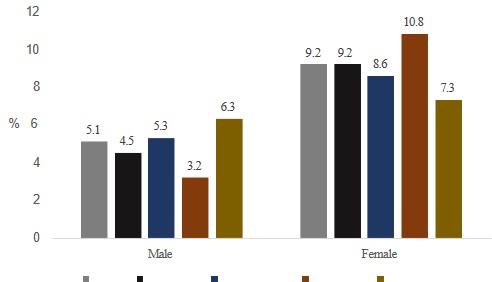
The prevalence of negative self-rated health was higher among older Brazilian women compared to men in all Brazilian regions (p<0.001) (Figure 1). The lowest prevalence of negative self-rated health was observed among men in the Southeast region, but this region had the highest prevalence among women compared to the others.
(Table 4) presents the crude and adjusted analyses of the association between leisure-time physical activity and negative self-rated health among elderly men and women in each Brazilian region. For men, the highest odds of reporting negative self-rated health were observed among those who were insufficiently active during leisure time in the Southeast and Central-West regions, compared to sufficiently active men. In contrast, among insufficiently active women in the Northeast region, there was six-fold greater odds (OR: 6.29; 95% CI: 6.106.49) of negative self-rated health compared to sufficiently active women.
Table 4: Association between leisure-time physical activity and negative self-rated health among older individuals in Brazilian capitals. 2023.
| Variables | Crude analysis OR (95%CI) | p | Adjusted analysis* OR (95%CI) | p |
|---|---|---|---|---|
| Male | ||||
| Regions | ||||
| North | 2.52(2.39-2.64) | <0.001 | 2.36(2.24-2.49) | <0.001 |
| Northeast | 6.48(6.20-6.77) | <0.001 | 6.27(6.00-6.55) | <0.001 |
| Central-west | 13.85(12.67-15.13) | <0,001 | 11.99(10.96-13.11) | <0.001 |
| Southeast | 20.02(18.92-21.18) | <0.001 | 27.46(25.94-29.06) | <0.001 |
| South | 2.68(2.59-2.78) | <0.001 | 3.04(2.93-3.17) | <0.001 |
| Female | ||||
| Regions | ||||
| North | 2.85(2.74-2.96) | <0.001 | 2.51(2.41-2.61) | <0.001 |
| Northeast | 5.91(5.74-6.09) | <0.001 | 6.29(6.10-6.49) | <0.001 |
| Central-west | 2.47(2.41-2.54) | <0.001 | 2.05(2.00-2.11) | <0.001 |
| Southeast | 2.25(2.22-2.28) | <0.001 | 2.07(2.05-2.10) | <0.001 |
| South | 2.33(2.25-2.41) | <0.001 | 2.57(2.48-2.66) | <0.001 |
Reference category: Active during leisure-time; OR: Odds Ratio; 95% CI: 95% Confidence Interval; *Adjusted for age, marital status, education level, screen time, physical activity during commuting, at home, and at work.
Discussion
Our objective was to estimate the association between leisure-time physical activity and negative self-rated health among older adults living in Brazilian capitals and the Federal District, using data from the 2023 VIGITEL system. We took into account gender and geographic region in our analysis. Our main finding indicates a significant association between insufficient leisuretime physical activity and poor self-rated health for both men and women across all geographic areas analyzed, compared to those who are sufficiently active. However, the strength of this association varies: it is stronger for men in the southeast and central-west regions, while for women, it is more pronounced in the northeast region. Additionally, we observed that, on average, the association’s strength is greater among men than among women.
Among women, there was a worse self-rated health compared to men as seen in other countries, although among older people this pattern is weaker than among other age groups [18]. Specifically, women seem to present more limitations than men for physical activities [19]. Despite that, the associations among insufficient leisure-time physical activity and negative self-rated health were stronger for men compared to women. These results are consistent with a previous study [20] that demonstrated the beneficial association between physical activity and better health-related quality of life among men, while women did not show this pattern. These differences could be related to the physical activity domain distribution among genders, with women showing a higher percentage of household physical activity and men being more engaged in occupational physical activity.
In Brazil, a significant link has been found between insufficient leisure-time physical activity and negative self-rated health, particularly among men in the Southeast region. This trend may be influenced by low levels of physical activity in various areas and the high prevalence of screen time in the region. Additionally, the Southeast is one of Brazil’s most developed areas, which typically correlates with higher socioeconomic status. Interestingly, this region also reported the lowest prevalence of negative self-rated health [21].
The stronger association observed for men in the Southeast, compared to other regions, along with a more pronounced association for women in the Northeast, highlights the disparities in self-rated health and physical activity across different regions, mainly Southeast and Northeast of Brazil for both genders [6,22].
This study emphasizes the inequalities present across geographic regions and genders, focusing on two key indicators and their relationship. It specifically examined older individuals with a maximum of eight years of education and low levels of physical activity, which may explain the significant associations found between insufficient leisure-time physical activity and negative self-rated health for both men and women. According to Patrão, Alves, and Neiva [23], various factors influence self-rated health among older Brazilian men and women. For men, higher levels of education and increased self-efficacy are associated with better self-rated health. For women, factors such as higher education, increased physical activity, social support, and self-efficacy are linked with improved self-rated health. Therefore, it is essential to implement educational programs and activities that enhance self-efficacy for both genders.
It is important to note that, despite observed inequalities highlighted also by Lima and collaborators [6] regarding the gender and disability which is related with self-rated health, the associations for men and women are largely similar across different regions, except for Southeast and Central-west. However, further studies are necessary to explore the potential causes specific to each region, identifying both similarities and differences. This understanding will enable the development of public policies that consider regional and gender-sensitive variations, ultimately encouraging physical activity among older adults.
This study adopted a minimum of 150 minutes of leisuretime physical activity as the threshold for sufficient practice, using this cutoff as a proxy for compliance with global recommendations established by international organizations [24] and adapted to the Brazilian context [25], which contribute to health promotion. This consideration is particularly relevant given that physical activity in Brazil in other domains, such as household, occupational, and commuting activities, is highly prevalent but in most cases does not represent a voluntary choice, rather a necessity [15]. Furthermore, different levels of engagement in physical activity [26] and variations in activity types or modalities [27] exert distinct influences on individuals’ self-rated health.
Community programs, intersectoral policies, and health education initiatives should particularly target groups with lower levels of education, greater socioeconomic vulnerability, and a higher risk of inactivity. Additionally, it is recommended that interventions aimed at reducing screen time be implemented, especially in urban areas, as a complementary approach to enhancing health and quality of life for the older population.
Although our findings provide valuable insights, it is important to acknowledge that the use of secondary data limited our access to information on self-efficacy and social support. Nevertheless, we were able to analyze a large sample from Brazilian capitals and the Federal District that represents the main cities in Brazil. Being a cross-sectional study, its ability to provide insights into causal relationships is limited due to the restricted number of covariates and the application of regression analysis, which does not account for potential mediators and moderators. Despite this limitation, the regression analysis serves as a foundation for future studies that aim to explore structural equation modeling and understand the roles of different variables.
Conclusion
Insufficient leisure-time physical activity is strongly linked to negative self-rated health among older adults in Brazil, with variations influenced by region and gender. Specifically, men demonstrate the strongest associations in the Southeast and Central-West regions. In contrast, women show a stronger association in the Northeast. Generally, men exhibit higher associations than women, except in the North and Northeast, where their values are similar. These findings underscore the need for public policies that promote physical activity while addressing socioeconomic and gender inequalities to enhance healthy aging.
References
- Kwaitana D, Bates MJ, Msowoya E, et al. Primary health care challenges: insights from older people with multimorbidity in Malawi – a qualitative study. BMC Public Health 2024; 24: 1434.
- Belachew A, Cherbuin N, Bagheri N, et al. A systematic review and meta-analysis of the socioeconomic, lifestyle, and environmental factors associated with healthy ageing in low and lowermiddle-income countries. Population Ageing 2024; 17: 365–387.
- Reis Júnior WM, Ferreira LN, Molina-Bastos CG, et al. Prevalence of functional dependence and chronic diseases in the community-dwelling Brazilian older adults: an analysis by dependence severity and multimorbidity pattern. BMC Public Health 2024; 24: 140.
- Gianfredi V, Nucci D, Pennisi F, et al. Aging, longevity, and healthy aging: the public health approach. Aging Clin Exp Res 2025; 37: 125.
- Dogra S, Dunstan DW, Sugiyama T, et al. Active aging and public health: evidence, implications, and opportunities. Annu Rev Public Health 2022; 43: 439–459.
- Olivares-Tirado P, Zanga R. Associations of physical activity and sedentary behavior with self-rated health status in Brazilian older adults. J Aging Phys Act 2025; 33: 51–62.
- Pereira ZS, da Silva AS, Melo JC do N, et al. Differential factors are associated with physical activity in older adults in Brazil with and without non-communicable chronic diseases: a cross-sectional analysis of the 2019 National Health Survey. Int J Environ Res Public Health 2023; 20: 6329.
- Costa AC de O, Duarte YA de O, Andrade FB de. Metabolic syndrome: physical inactivity and socioeconomic inequalities among non-institutionalized Brazilian elderly. Rev Bras Epidemiol 2020; 23: e200046.
- Souza AMR, Fillenbaum GG, Blay SL. Prevalence and correlates of physical inactivity among older adults in Rio Grande do Sul, Brazil. PLOS ONE 2015; 10: e0117060.
- da Silva AS, Melo JC do N, Pereira ZS, et al. Correlates of physical activity in Brazilian older adults: the National Health Survey 2019. Int J Environ Res Public Health 2023; 20: 2463.
- Peixoto SV, Mambrini JV de M, Firmo JOA, et al. Physical activity practice among older adults: results of the ELSI-Brazil. Rev Saude Publica 2018; 52 Suppl 2: 5s.
- Ferrari Junior GJ, Teixeira CS, Felden ÉPG. Socioenvironmental factors and behaviors associated with negative self-rated health in Brazil. Cien Saude Colet 2021; 26: 4309–4320.
- Reinwarth AC, Wicke FS, Rückert KK, et al. Change of self-rated physical health predicts mortality in aging individuals: results of a population-based cohort study. Arch Public Health 2024; 82: 130.
- Dramé M, Cantegrit E, Godaert L. Self-rated health as a predictor of mortality in older adults: a systematic review. Int J Environ Res Public Health 2023; 20: 3813.
- Ramirez Varela A, Hallal PC. Does every move really count towards better health? Lancet Glob Health 2024; 12: e1215– e1216.
- Ainsworth BE, Haskell WL, Herrmann SD, et al. 2011 Compendium of Physical Activities: a second update of codes and MET values. Med Sci Sports Exerc 2011; 43: 1575–1581.
- Monteiro CA, Florindo AA, Claro RM, et al. Validity of indicators of physical activity and sedentariness obtained by telephone survey. Rev Saude Publica 2008; 42: 575–581.
- Boerma T, Hosseinpoor AR, Verdes E, et al. A global assessment of the gender gap in self-reported health with survey data from 59 countries. BMC Public Health 2016; 16: 675.
- Stalling I, Gruber M, Bammann K. Sex differences in physical functioning among older adults: cross-sectional results from the OUTDOOR ACTIVE study. BMC Public Health 2024; 24: 1766.
- Liao Y-H, Kao T-W, Peng T-C, et al. Gender differences in the association between physical activity and health-related quality of life among community-dwelling elders. Aging Clin Exp Res 2021; 33: 901–908.
- Trachte F, Geyer S, Sperlich S. Impact of physical activity on selfrated health in older people: do the effects vary by socioeconomic status? J Public Health (Oxf) 2016; 38: 754–759.
- Lima ALB de, Espelt A, Bosque-Prous M, et al. Diferenças de gênero na incapacidade entre idosos no contexto das desigualdades sociais de gênero e renda: Pesquisa Nacional de Saúde de 2013. Rev Bras Epidemiol 2020; 23: e200002.
- Patrão AL, Alves VP, Neiva TS. Gender differences in psychosocial predictors of self-perceived health status in the elderly: evidence from a Brazilian community study. J Women Aging 2018; 30: 553–570.
- Bull FC, Al-Ansari SS, Biddle S, et al. World Health Organization 2020 guidelines on physical activity and sedentary behaviour. Br J Sports Med 2020; 54: 1451–1462.
- Brasil. Ministério da Saúde. Secretaria de Atenção Primária à Saúde. Departamento de Promoção da Saúde. Guia de Atividade Física para a População Brasileira. Brasília: Ministério da Saúde; 2021.
- Li L, Dai F, Zhang D. The effect of exercise intensity types on the self-rated health status of young-old comorbidities patients: a cross-sectional study in Guangdong, China. Front Public Health 2023; 11: 1292712.
- Blake HT, Crozier AJ, Buckley JD, et al. Examining the relationship between different physical activities and health and well-being in middle-aged and older men: an isotemporal substitution analysis. BMJ Open Sport Exerc Med 2024; 10: e001875.